
Buyers researching a factory run into our domestic storefronts before they run into this website, and then ask a reasonable question: what is ALWAYSMISS, and is it the same company?
This page is the answer, written once so it does not have to be explained in each email. It is pinned to the top of the blog because it is reference material rather than a dated article.
The storefronts
Both are Chinese-language storefronts on Pinduoduo, selling to the domestic market. Neither is an export channel.
| Storefront | Brand | Units sold | Role |
|---|---|---|---|
| FLECHAZO 毛绒玩具旗舰店 | FLECHAZO | 45,000+ | Flagship store, run by the manufacturer |
| ALWAYSMISS 玩偶旗舰店 | ALWAYSMISS | 12,000+ | Authorised sub-store, same manufacturer |
| Combined | 50,000+ | Across two storefronts |
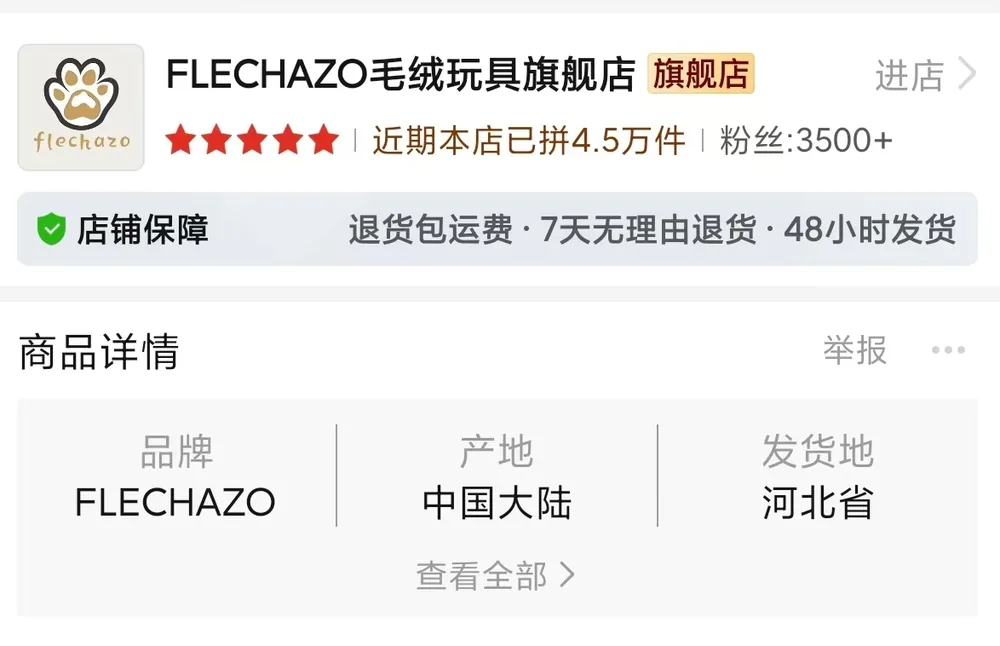
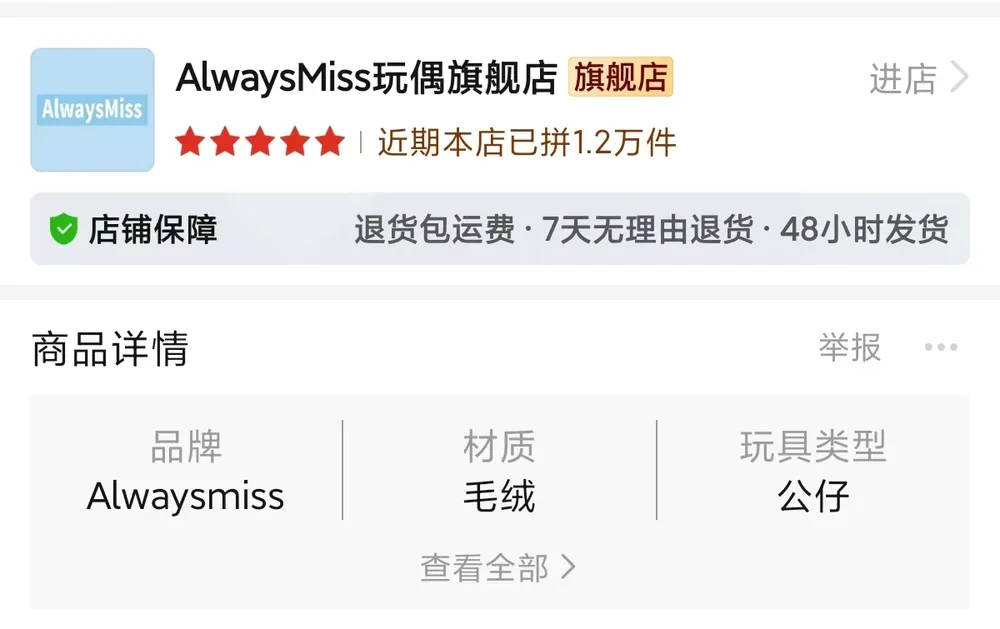
Units sold, as reported on each storefront

FLECHAZO flagship   ###################  45,000+
ALWAYSMISS store    #####                 12,000+
                    +----+----+----+----+----+
                    0    10   20   30   40   50  (thousand units)
The counters are the platforms’ own, displayed on the storefront pages. They are not a figure we calculated.
What ALWAYSMISS is
An authorised sub-store: a second storefront, under a second brand name, used to sell our own production in the Chinese domestic market.
It is worth being precise about what that means, because the failure modes for a buyer are not obvious.
- It is not a separate factory. The goods come off the same cutting tables, the same sewing lines and the same needle-detection pass as the flagship store’s goods and as the export orders.
- It is not a reseller of other factories’ stock. A sub-store that buys from whoever is cheapest is common in this market; ours is a second brand for our own output.
- It is not a competitor. A buyer who finds both storefronts and assumes they are rivals bidding for the same work has the relationship backwards.
- It is not an export channel. Neither storefront quotes FOB, handles containers or issues export documentation. That is this site and the export team.
What the 50,000 figure does and does not mean
Two things are both true, and conflating them is how numbers on a factory page stop being useful.
What it measures: units sold through two domestic retail storefronts, as counted by the marketplace. It is a demand signal - it tells you that the styles we design are bought at retail, not only selected by buyers.
What it does not measure: our OEM/ODM export volume. That runs at a published 100,000 pieces per month across the 12,000+ m² workshop, and it is a different number on a different clock. Adding the two together would produce a total that means nothing.
We would rather state both separately than present one impressive sum.
How to verify any of this
A claim in a paragraph is worth what the reader can check. Here is where.
| Claim | Where to check it |
|---|---|
| The two storefronts exist and belong to us | Both are public on Pinduoduo; the storefront pages show the brand and the sales counter |
| ALWAYSMISS is authorised, not independent | Compare the manufacturer named on the product’s own paperwork - the test report and the certificate identify the factory, not the storefront |
| The storefronts sell our production | Same brand-owner entity on the store registration as on the export contract |
| The factory exists and is audited | BSCI and ISO 9001 certificates, and the address on a current test report |
| Export volume | The published capacity figures, and a factory visit if the order justifies one |
The last row is the only one that cannot be checked from a desk. It is also the only one that settles the question properly.
Why a domestic storefront is useful to an OEM buyer
Not a marketing point - a practical one.
Retail volume produces wear reports. A plush sold 45,000 times through a domestic storefront generates returns, reviews and complaints at a volume no sampling programme can match: which seam opens first, which print cracks, which style sags after a month in a child’s bed. That feedback reaches the pattern room before it reaches a buyer’s inbox.
When a specification is being written for an export order, the questions that matter - does the ear hold its shape, does the fill recover, does the embroidery pucker on that curve - usually already have an answer from the domestic line.
Frequently asked questions
Is ALWAYSMISS the same company as FLECHAZO?
Yes. ALWAYSMISS is an authorised sub-store selling our own production in the Chinese domestic market, under a second brand name. It shares the factory, the pattern room and the inspection regime with FLECHAZO. It is not a separate manufacturer, a reseller of third-party goods, or a competitor.
Is the 50,000 units figure our OEM/ODM volume?
No. It is domestic retail volume through two Pinduoduo storefronts, counted by the platform. OEM/ODM export volume is published separately at 100,000 pieces per month. The two numbers measure different things and are not added together.
Can an export buyer order through the domestic storefronts?
No. The storefronts are Chinese-language retail channels and do not quote FOB, handle containers or issue export documentation. Export enquiries go through this site, where the age grade, fabric, fill weight and inspection plan are stated on the quotation.
Why is this post pinned?
Because it answers a question that recurs, and because a page that explains the company should not drift down a date-ordered list while newer technical articles are published above it.
Where this stops
- The sales counters move. They are read from the storefronts and change as the storefronts trade. The figures on this page are a snapshot, not a promise; check the storefronts for the current ones.
- The platform label is “recently sold”, not necessarily lifetime. The storefronts display a recent-sales counter; we quote the numbers the platform shows rather than restating them as a lifetime total in a way the platform does not support.
- Domestic retail and export compliance are different regimes. A product sold domestically in China meets GB 6675; an export order is tested to the standard of the destination market, which may be EN 71, ASTM F963 or both.
References
-
FLECHAZO 毛绒玩具旗舰店, Pinduoduo storefront - flagship store, sales counter and brand details shown on the storefront page.
-
ALWAYSMISS 玩偶旗舰店, Pinduoduo storefront - authorised sub-store, sales counter and brand details shown on the storefront page.
-
GB 6675.1 to GB 6675.4 - Chinese national toy safety standard, the regime domestic Chinese retail falls under.
-
EN 71-1, EN 71-2, EN 71-3 and ASTM F963-23 (mandatory in the United States via 16 CFR § 1250.2(a)) - the regimes an export order is tested to.
Related reading
- Custom plush toy manufacturing: standards, specifications, MOQ and lead times
- What each plush toy certificate proves, and what it does not
- Why the same plush toy gets quoted 21% to 76% apart
- The stock catalogue: the same styles the storefronts sell, with fabric, filling and MOQ stated per design
Flechazo operates a 12,000+ m² workshop with 200+ production staff and a monthly output of 100,000 pieces, running 100% needle detection and AQL 2.5 inspection. MOQ from 100 pieces per design; samples in 5 to 7 days.